How to build a recruiter network as a data analyst
Applying through the Apply button puts you in a pile of two hundred. A recruiter who already knows your name reads you first. Here is how to find the right recruiters, what to write, and a twenty-minute weekly routine that does not feel like spam.
When a data analyst role goes up on LinkedIn, it gets two hundred applications in a week. Most of them come through the Apply button. The recruiter opens that pile last. They open the people they already know first. This guide is about becoming one of those people, without turning into a spammer.
Why networking with recruiters works
A recruiter's job is to fill roles quickly with people who will not embarrass them. The pile from the Apply button is slow and risky: hundreds of unknown profiles to screen. A candidate they have already seen, whose portfolio they have already opened, is fast and safe.
That is the whole mechanism. You are not asking for a favour. You are making their job easier, by being a known quantity before the role opens.
It also compounds. A recruiter you connected with in March is still there in September, for a different role, often at a different company.
Step 1: find the right recruiters, not all of them
The mistake is connecting with everyone who has "recruiter" in their title. Most of them never hire for your role or your country, and your feed fills with noise.
The right recruiters are the ones who actually post offers that match your target. Your target is one role (data analyst, say), one market (the Netherlands, or remote in Europe), one seniority. Then look for the people who, in the last three months, posted roles like that.
Three ways to find them:
- On LinkedIn, by hand. Search for your role title, filter by posts, and look at who posted, not only the company. Open the profile. Is it a person at the company (in-house) or an agency? What else did they post? Note the name.
- From the offers themselves. Every job you find interesting has a human behind it. Before applying, find who posted it or who the hiring manager is. It is often written in the post.
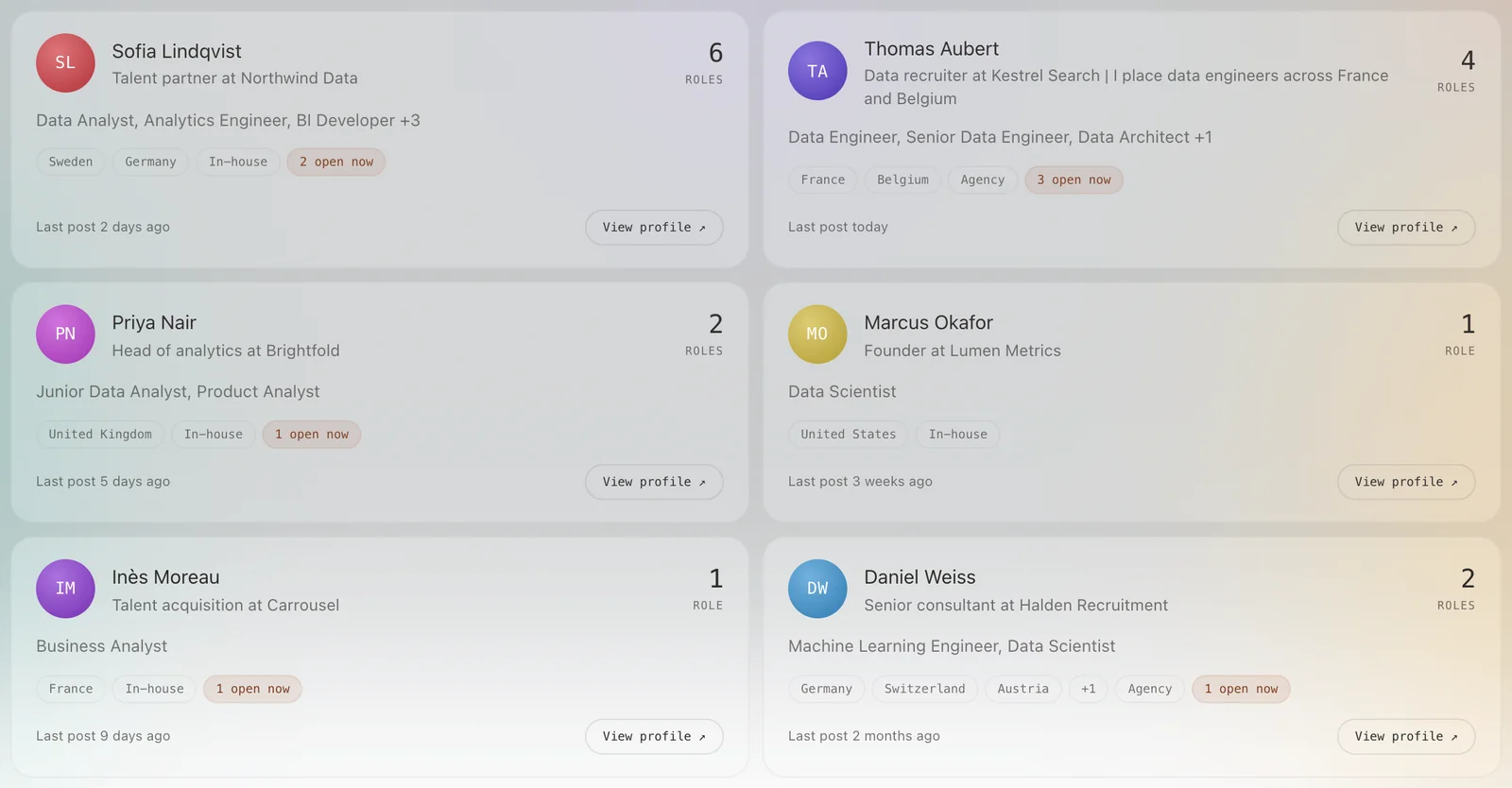
- With the D8A recruiters directory. For members, the jobs tab has a Recruiters segment. It lists the people behind the validated offers in the feed: name, headline, the roles they have posted, the countries, in-house or agency, how many roles are open now, and when they last posted. You can search by role or company, filter by country, and sort by most active. It saves the hour of scrolling, and it only shows recruiters who really post data roles.
Whichever way, aim for a list of twenty to thirty names, in a spreadsheet or a notes file. Name, company, in-house or agency, the role they posted, the date you contacted them.
Both are useful, differently. In-house recruiters know one company deeply and will remember you for the next opening there. Agency recruiters work many companies and move fast, but they work for the client, not for you. Keep both on your list, and expect faster replies from agencies and longer memories from in-house.
Step 2: the first contact
Send a connection request. On LinkedIn, a request without a note has a better acceptance rate than most notes people write, because most notes are a pitch. If you add a note, keep it to one line and make it about them, not you:
Hi Anna, I saw your post for the Data Analyst role at Bol. I follow the roles you post for the Dutch market, happy to connect.
No CV. No "I am looking for opportunities". No link yet. You are asking to be in their network, not for a job.
Once they accept, wait a day, then send one real message. The structure is always the same: who you are in one line, one project with the link, one question they can answer in one sentence.
Thanks for connecting. I am a data analyst, moving into e-commerce analytics after four years in retail operations. Here is the project I am most proud of, a returns analysis on a real dataset: d8a.academy/portfolio/your-name. Quick question: for the roles you post, do teams prefer Power BI or Looker these days?
The question matters. It gives them an easy reason to reply, and the reply tells you something true about the market. "Do you have anything for me?" gets ignored. "Power BI or Looker?" gets an answer.
Step 3: stay visible without spamming
Now the slow part, and the part most people skip. A recruiter who accepted your request and got one message will forget you in two weeks. The goal is to show up in their feed, lightly, over months.
- Comment on their posts. When they post a role, a short, useful comment ("Nice, this one asks for dbt, which is rarer for analyst roles in NL") is read by them and by everyone who sees the post. One or two sentences. Never "Interested!" and never "DM me".
- Post about your own work once a month. One project, one chart, three lines on what you found. Link the portfolio. Recruiters in your network see it. This is the single most effective thing on this list and the one people do least.
- React to the offers they publish. It costs nothing and keeps you in the algorithm's idea of their network.
- Update them when something changes. New project, new certification, moved country: one line, with the link. Not more than once every six weeks.
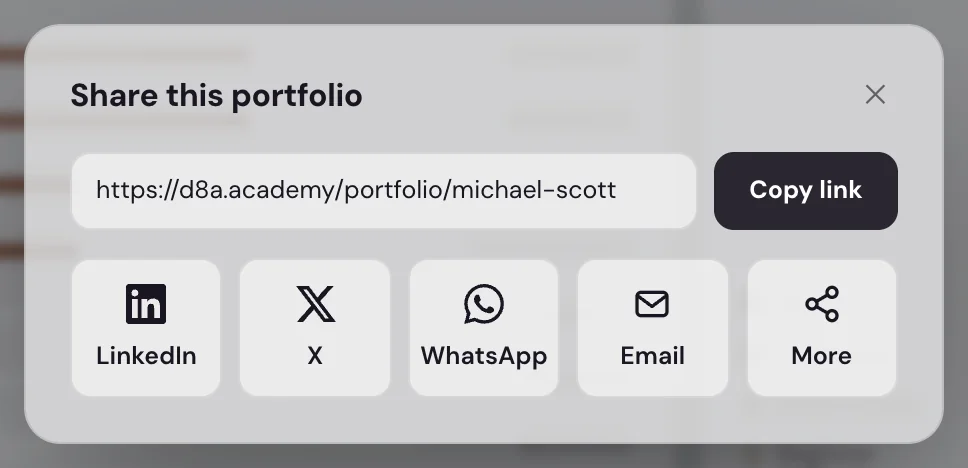
Your portfolio page is what makes this work. Every post and every message points to the same link, and that link should be current. If you built it on D8A, the share dialog gives you the link and a one-click LinkedIn share.
Step 4: when an offer comes out
This is where the network pays. A recruiter you know posts a role that fits. Do not only click Apply. Do both:
- Apply through the form, with the text-only CV, so you exist in their system.
- Send the recruiter a short message, the same day:
Hi Anna, I just applied for the Data Analyst role at Bol. The returns analysis I shared in April is the closest thing to what the post describes, here it is again: link. Happy to talk whenever suits you.
Short, one project, the link. You are reminding them you exist and giving them a reason to pull your file out of the pile.
The weekly routine: twenty minutes
None of this works as a one-off. It works as a small habit. Here is one that fits in twenty minutes, once a week:
| Minutes | What |
|---|---|
| 5 | Add five new recruiters to your list and send five connection requests |
| 5 | Send the one real message to whoever accepted this week |
| 5 | Leave three short, useful comments on recruiters' posts |
| 5 | Once a month, post one project. The other weeks, update your spreadsheet |
After a month, twenty recruiters know your name. After three months, sixty, and some of them have replied. That is a network. It did not take more time than one evening of applying through forms, and it will still be there for your next move.
What not to do
- Do not send your CV in the first message. Nobody asked.
- Do not ask "do you have anything for me?". It puts the work on them.
- Do not connect with fifty recruiters in one day. LinkedIn limits it, and it looks like what it is.
- Do not lie about your level. Recruiters talk to each other, and a lie costs you the whole list.
- Do not give up after two silent weeks. Recruiters reply when they have a role, not when you write. The point is to be there when they do.