DA, DS, DE, BA: what's the actual difference?
Data Analyst, Data Scientist, Data Engineer, Business Analyst: four titles that overlap on every job board. Here's a clear map so you can pick your path.
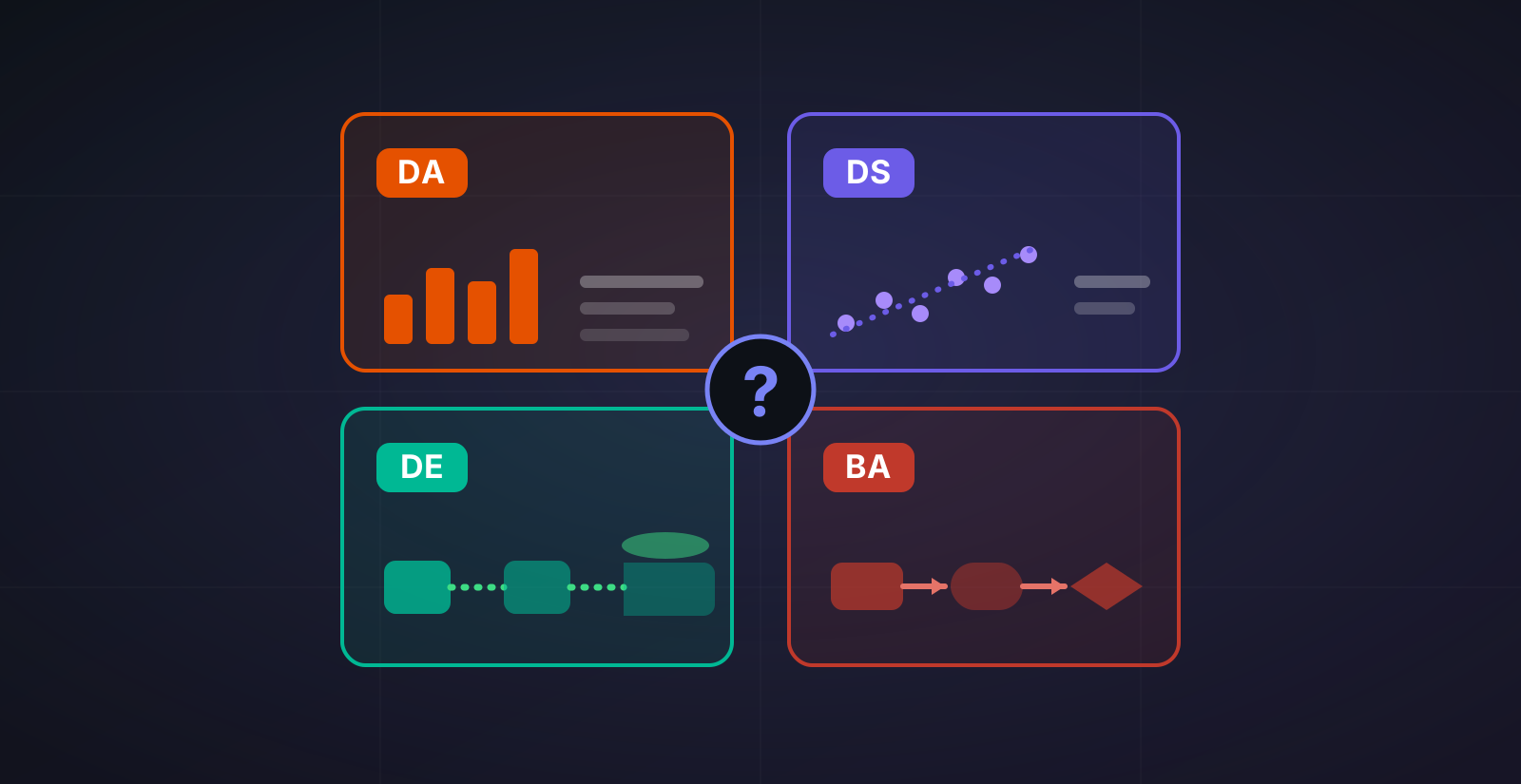
Data Analyst, Data Scientist, Data Engineer, Business Analyst: four titles that seem to overlap at every job board. Here's a clear map so you can pick your path and stop second-guessing yourself.
Why does everyone mix them up?
Browse LinkedIn for five minutes and you'll find Data Analysts who build ML models, Data Scientists who write SQL all day, and Business Analysts who somehow manage the data pipelines. Job titles in data are notoriously inconsistent: they vary by company size, industry, and whoever wrote the JD.
That said, the roles do have distinct centers of gravity. Understanding those centers helps you target the right jobs, build the right skills, and write a CV that doesn't try to be everything at once.
Core definitions
Answers specific business questions using existing data. Turns numbers into narratives that non-technical stakeholders can act on. SQL-first, dashboard-heavy, business-close.
Builds statistical models and ML systems to predict, classify, or cluster. Works on open-ended, exploratory problems where the answer isn't known upfront. Heavy on math and code.
Designs and maintains the pipelines that move, transform, and store data. The plumbing that keeps everything else running. Without data engineers, analysts have no data to analyze.
Bridges business stakeholders and technical teams. Defines requirements, maps processes, and measures outcomes. May or may not write code, depending heavily on the company.
What actually separates them
To see each of these roles play out across a real working day, read our day-in-the-life series, starting with a day in the life of a data analyst.
The ratings below reflect how prominently each dimension appears in the role, not a strict pass/fail. ●●● High · ●● Medium · ● Low · ○ Minimal
| Dimension | DA | DS | DE | BA |
|---|---|---|---|---|
| SQL depth | ●●● | ●● | ●●● | ● |
| Statistics and ML | ● | ●●● | ● | ● |
| Python / coding | ● | ●●● | ●●● | ● |
| Data pipelines | ● | ●● | ●●● | ○ |
| Dashboard / viz | ●●● | ●● | ● | ●● |
| Stakeholder comms | ●●● | ●● | ● | ●●● |
| Process mapping | ●● | ● | ● | ●●● |
| Cloud / infra | ● | ●● | ●●● | ○ |
| Avg. market salary (EU) | €40-65k | €55-90k | €55-85k | €35-60k |
Where the roles blur and why
In small companies, one person often covers multiple roles out of necessity. In large orgs, the lines are sharper but the job titles drift anyway. These are the four most common overlaps:
DA ↔ DS. Senior DAs often build predictive models. Junior DSes spend most of their time cleaning data and writing SQL. The line is usually where "experimentation" begins and how much the role expects productionized ML output.
DA ↔ BA. Both talk to business stakeholders. DAs answer questions with data; BAs answer questions with process analysis and requirements. In practice: if the deliverable is a dashboard, it's DA. If it's a Confluence doc or a requirements spec, it's BA.
DA ↔ DE. DAs increasingly build their own dbt models and light pipelines. DEs increasingly write analytical SQL. The split is roughly: if you care about the insight, you're more DA. If you care about the reliability of the pipe, you're more DE.
DS ↔ DE. ML Engineering sits squarely here. Data Scientists build models; Data Engineers deploy and serve them. At many companies this is split into a dedicated MLOps function, at smaller ones the DS does both.
Which one is right for you?
Honest question: what energizes you more, the result or the mechanism?
I love turning messy data into a clear story
You enjoy SQL, you're comfortable in BI tools, and you get satisfaction from a dashboard that actually changes a decision. Data Analyst is your natural starting point, and the most accessible entry into the data field.
I want to build systems that predict things
You're comfortable with math, you enjoy exploring uncertainty, and you want to write algorithms, not just read their outputs. Expect a steeper learning curve, but the ceiling for impact (and salary) is higher. Data Scientist is your target.
I care more about infrastructure than insight
You like building reliable systems. You think in pipelines, schemas, and SLAs. You're closer to software engineering than to analytics. Data Engineering is your lane, and one of the most in-demand roles in the market right now.
I'm strongest when I'm in the room with stakeholders
You're a natural facilitator. You translate between what business wants and what tech can deliver. You're less interested in writing code than in mapping processes and measuring outcomes. Business Analyst fits you, and it's often the most underrated path into data.
Start with the question you most want to answer, then learn whatever skill gets you there fastest. The title follows the work.
Where most people start at D8A: Data Analysis
D8A has a guided path for each of the four roles, so you can start wherever fits you best. That said, Data Analysis is where we point most newcomers, not because it's the easiest path, but because it's the most universally transferable foundation. SQL, Python basics, visualization, and storytelling with data are skills you'll need regardless of which direction you eventually specialize.
Once you've got those fundamentals, branching into Data Science, Data Engineering, or deepening your BA skills becomes a much shorter road. Think of DA as the base layer: everything else stacks on top of it.
Still not sure which direction is yours? Our quiz takes two minutes and points you to the path that best fits your background.