DataCamp vs Coursera vs building a portfolio: what actually gets you a data job
DataCamp and Coursera are two of the most popular ways to learn data skills, and both are useful. But neither is what gets you hired. Here is an honest comparison of what each one is for, and the deliverable that turns learning into interviews.
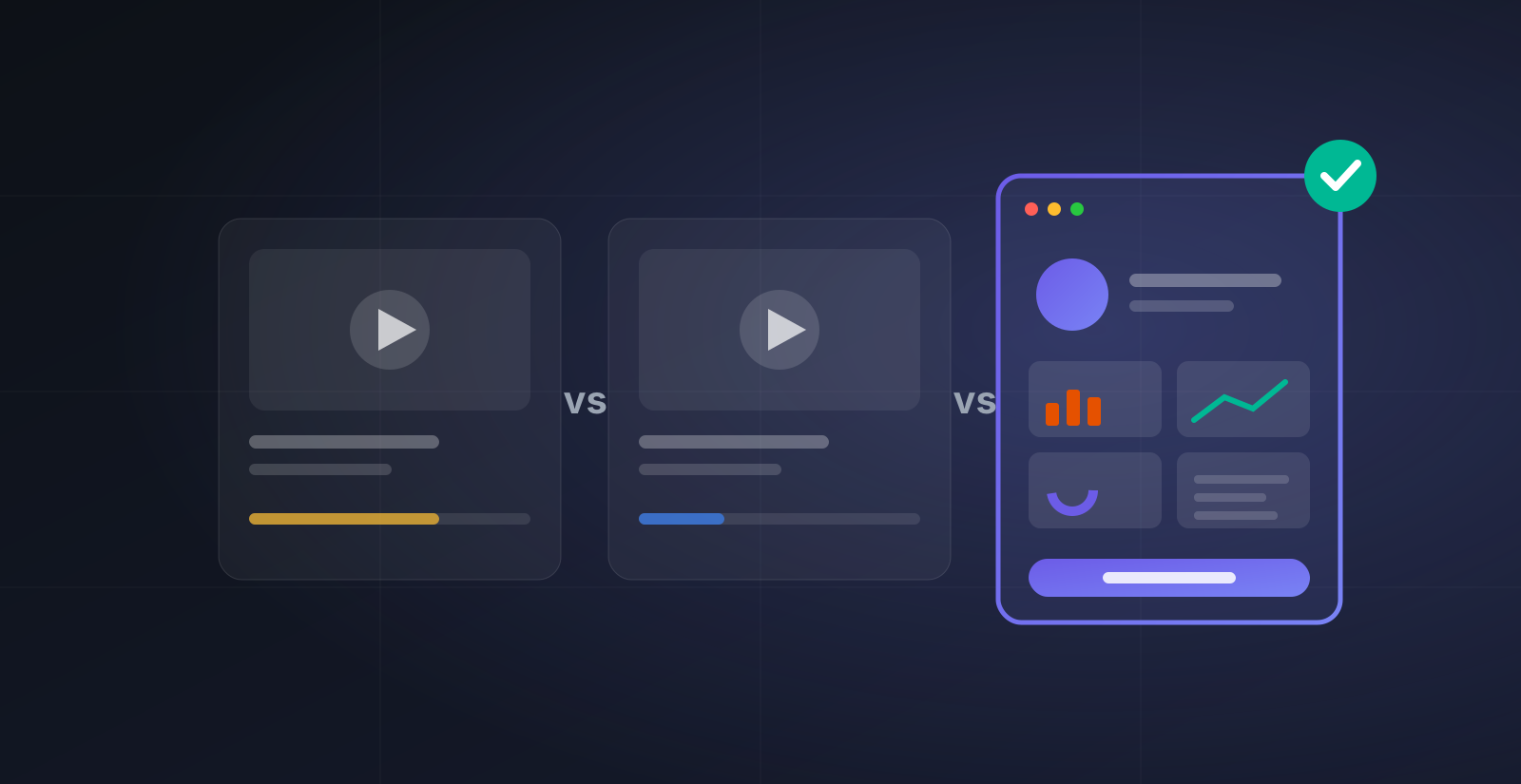
DataCamp or Coursera is the question most people ask when they decide to break into data. It is a reasonable question, and both are good tools. But it is also the wrong question, because it quietly assumes that finishing a course is what gets you hired. It is not. The thing employers act on is a portfolio, and that reframes how you should use either platform.
What each one is actually for
DataCamp and Coursera are not really competitors. They solve different halves of the "learning" problem, and both do their half well.
DataCamp
Short, hands-on exercises in SQL, Python, and R. Best for building and maintaining muscle memory. You practise a lot of small skills quickly, in the browser, with instant feedback.
Coursera
Structured, university- and industry-backed courses, including the Google Data Analytics Certificate. Best for fundamentals and a recognised credential that clears automated CV filters.
A portfolio
Not a place to learn, but the thing you produce. Real projects on messy data, published where a recruiter can open them. This is what an employer actually evaluates.
Notice that the first two are inputs and the third is the output. That is the distinction the "DataCamp vs Coursera" debate misses entirely.
The thing they both leave out
Here is the honest limitation of a course-only approach, whichever platform you pick.
- Fundamentals in the right order
- Technical skills and syntax
- A credential or completion badge
- Guided practice on clean data
- Confidence that you know the tools
- Whether you can frame a business question
- Whether you can clean real, broken data
- A recommendation you stand behind
- Work you can defend in an interview
- Any proof you can do the job unguided
This is why people finish a stack of courses and still get silence from applications. They optimised the input and never produced the output.
How to actually use them: inputs, then output
The winning approach is not to pick one platform. It is to treat learning as a means and a portfolio as the end.
- 1
Learn the fundamentals once
Use Coursera or a structured course to get the fundamentals in order. One credential is plenty. A second one is procrastination dressed up as progress.
Questions to ask- Pick one structured source, not five
- Cover cleaning, SQL, and visualisation
- Do not chase a second certificate
- 2
Drill the skills until they stick
This is where DataCamp-style drilling earns its place. Keep it, but keep it in proportion. Drilling is preparation, not the performance.
Questions to ask- Short, frequent practice beats marathons
- Focus on SQL and Python muscle memory
- Stop when the syntax is automatic
- 3
Turn it into a portfolio
Spend the majority of your effort here. Two or three finished, public projects are the deliverable that every hour of learning was supposed to build toward.
Questions to ask- Real datasets and real business questions
- Cleaning, analysis, and a clear recommendation
- Public, documented, easy to open
Do this and the "vs" dissolves. You use a course to learn, drilling to sharpen, and a portfolio to get hired. The mistake is spending all your effort on the first two and never reaching the third.
A certificate says you watched a course. A portfolio says you can do the work. Recruiters can tell the difference.
What the output looks like, across roles
A portfolio is role-specific, and the right one depends on the job you want. If you are still deciding, our guide to the actual difference between DA, DS, DE, and BA is the place to start. Here is what a finished portfolio looks like for two of the most common paths.
SQL foundations, a Python analysis, a BigQuery and GA4 project, and a Power BI dashboard, each finished and documented.
“World's best boss of business intelligence. I make SQL look easy and hard truths sound like a 'that's what she said.'”
Open the portfolio →Python and statistics, a supervised learning model, a time-series forecast, and a deep-learning project, built end to end.
“Data Scientist. I build models that predict things. Mostly they predict that Dwight will fall for it. He does.”
Open the portfolio →The verdict
DataCamp versus Coursera is a false choice. Both are good at what they do, and both leave the same thing undone: the proof that converts learning into a job offer. Pick whichever suits how you like to learn, spend as little time there as it takes to get competent, and then pour your real effort into a portfolio.
That last step is the one most people never finish, because building real projects from a blank page is slow and daunting. It is also the exact step D8A removes. Each path turns the skills you would otherwise drill in isolation into guided, real-world projects, auto-validated as you complete them and published straight to a public portfolio. You still learn, but every hour goes toward proof an employer can open, which is the only part of this whole debate that actually gets you hired.