Star schema vs snowflake: which one should you use?
The two classic warehouse shapes, when each one wins, and the vocabulary interviewers expect. Diagrams included, plus a free PDF.
Get the free PDF
One page, print-ready, free to share. No signup needed.
Both shapes put one fact table in the middle. The difference is what happens to the dimensions around it: a star keeps them flat, a snowflake keeps splitting them into sub-dimensions. That one choice drives joins, speed, and how pleasant the model is to work with.
The two shapes
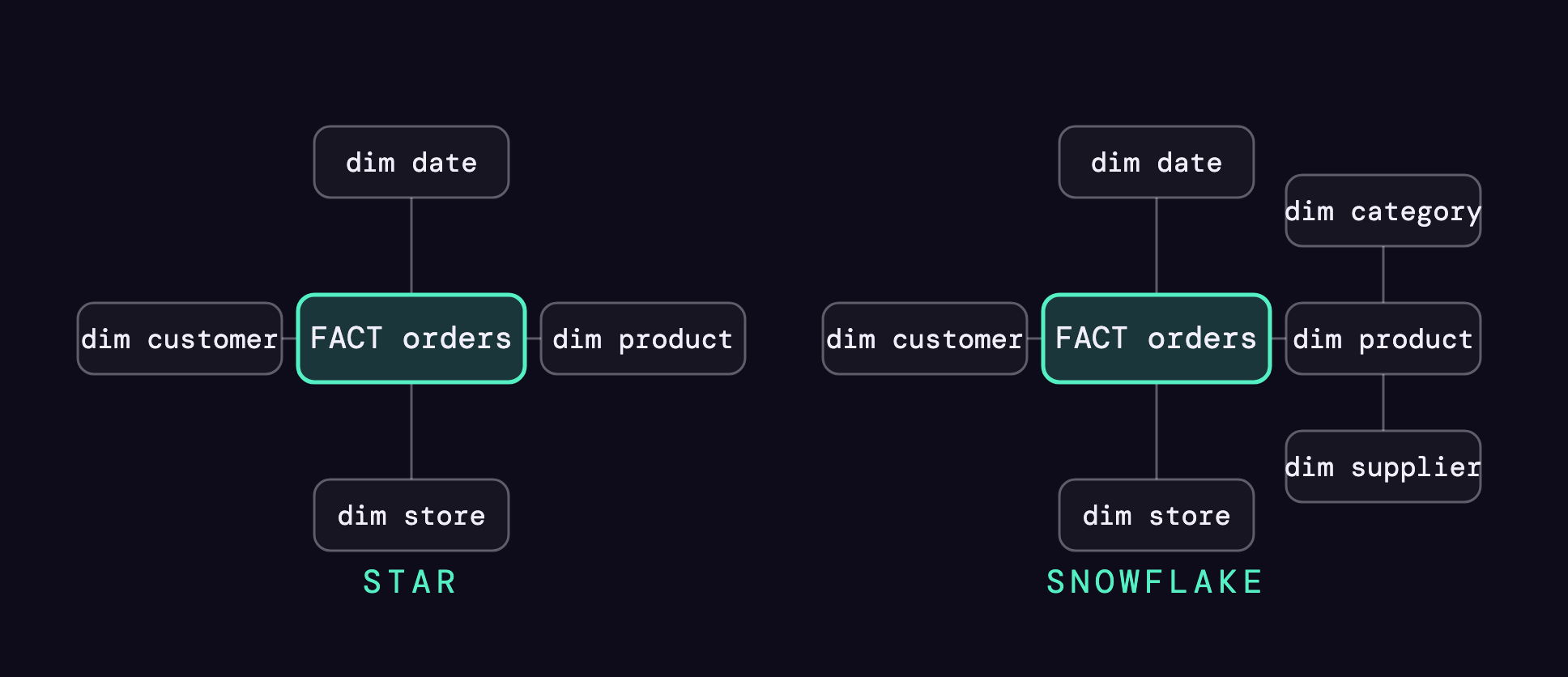
Star: a fact table (orders) surrounded by flat, denormalized dimensions: customer, product, date, store. One join per dimension.
Snowflake: same center, but dimensions normalize further: product splits into category and supplier, geography splits into city, region, country. Joins multiply.
Side by side
| star | snowflake | |
|---|---|---|
| dimensions | denormalized, flat | normalized, split |
| joins per query | fewer | more |
| storage | a bit more | a bit less |
| BI tool fit | excellent | clunkier |
| maintenance | simpler | stricter |
When to pick which
Star when: you feed BI dashboards (fewer joins, faster reads), the team is small (simpler to reason about), and you run a cloud warehouse where storage is cheap anyway.
Snowflake when: big hierarchies are genuinely shared across facts, or dimension consistency must be updated in exactly one place. Storage-bound arguments are mostly a relic.
The trap: snowflaking to save storage
You save cents per GB on normalized dimensions and pay in extra joins on every dashboard query, forever. Normalization is for OLTP systems that write constantly; warehouses deliberately trade redundancy for read speed.
Default to star. Choose snowflake only with a reason you can say out loud.
The vocabulary
- fact table: events and measures: orders, sessions, payments
- dimension: context: customer, product, date, store
- grain: what one fact row means. Decide it first, everything follows.
- surrogate key: warehouse-generated id joining facts to dimensions
Frequently asked questions
Which is faster, star or snowflake?
Is a snowflake schema ever the right choice?
What is the difference between a fact table and a dimension table?
Does Power BI prefer a star schema?
Get the free PDF
One page, print-ready, free to share. No signup needed.