Overfitting explained: why does your model fail the test set?
The difference between learning the pattern and memorizing the noise, how to diagnose which one your model did, and the five fixes.
Get the free PDF
One page, print-ready, free to share. No signup needed.
Show the same scatter of points to three models. The too-simple one draws a straight line through a curve. The right one draws the trend. The too-flexible one threads through every single point, noise included. That third model looks perfect on paper and fails in production: that is overfitting.
Three fits, same data
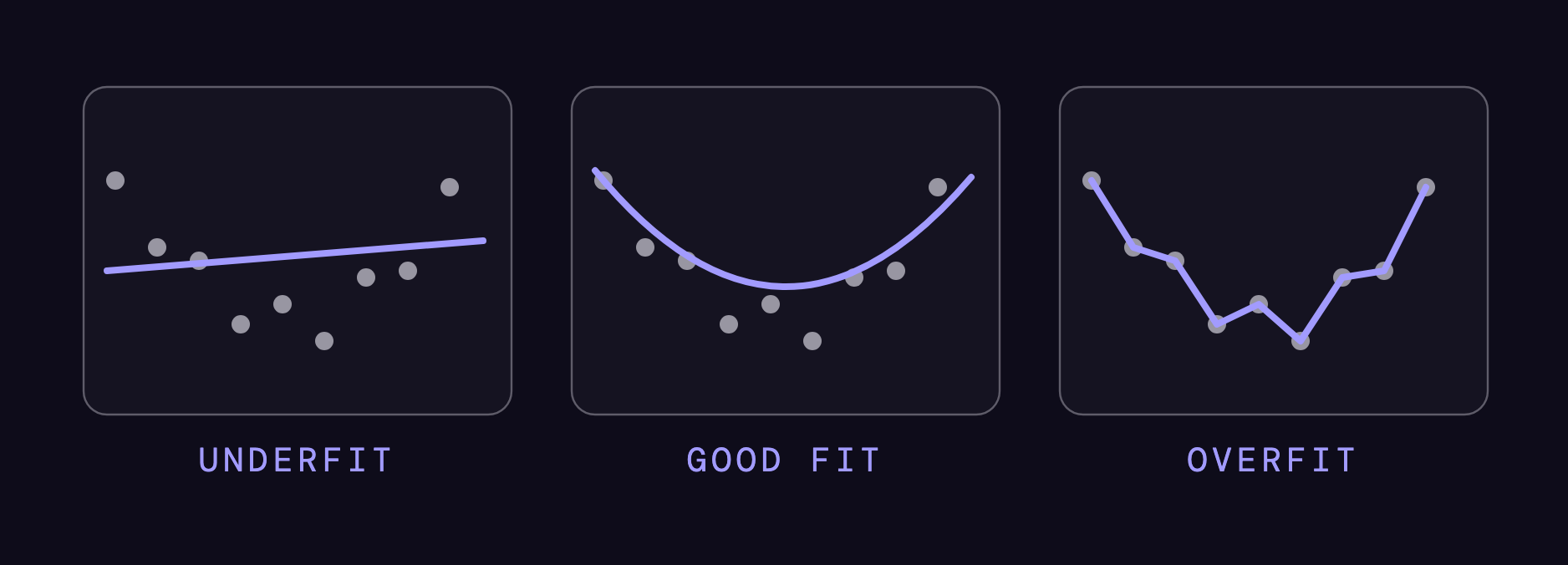
- Underfit: too simple to see the shape. High error on training data, high error on test data.
- Good fit: learned the trend, ignores the wiggles. Low error on both.
- Overfit: memorized every wiggle of noise. Near-zero training error, high test error.
The classic analogy: a student who memorized past exams aces every practice test and fails the real one.
Diagnose yours
| Underfitting | Overfitting | |
|---|---|---|
| train error | high | near zero |
| test error | high too | high |
| cause | model too simple | model memorized noise |
| fix | more features, capacity | simplify, regularize |
Compare train error vs test error. The gap is the diagnosis.
Five fixes that work
In rough order of how often they are the right answer:
- More data: noise averages out with volume.
- Simpler model: fewer parameters to memorize with.
- Regularization: L1/L2 penalties on extreme weights.
- Early stopping: quit training while validation still improves.
- Cross-validation: five splits for an honest estimate, so you catch the problem before production does.
The trap: test-set leakage
Scale, encode, or select features BEFORE the train/test split and your test score is fiction: the preprocessing saw the test rows, so information leaked.
- The symptom: great offline metrics, embarrassing production performance.
- The fix: split first; fit every transform on the training set only.
This is exactly why sklearn's Pipeline exists. Use it and the leak becomes structurally impossible.
Frequently asked questions
How do I detect overfitting?
What is the difference between overfitting and underfitting?
Does more data always fix overfitting?
What is regularization in one sentence?
Get the free PDF
One page, print-ready, free to share. No signup needed.