ETL vs ELT: which one should you choose?
Where the Transform step runs decides your tooling, your costs, and who gets to shape the data. The full comparison, plus a free PDF.
Get the free PDF
One page, print-ready, free to share. No signup needed.
ETL and ELT do the same three things: Extract data from sources, Transform it into something usable, Load it into a destination. The entire debate is about the order of the last two letters, because that order decides where the work happens, what tools you need, and who can do the transforming.
Two orders of operations
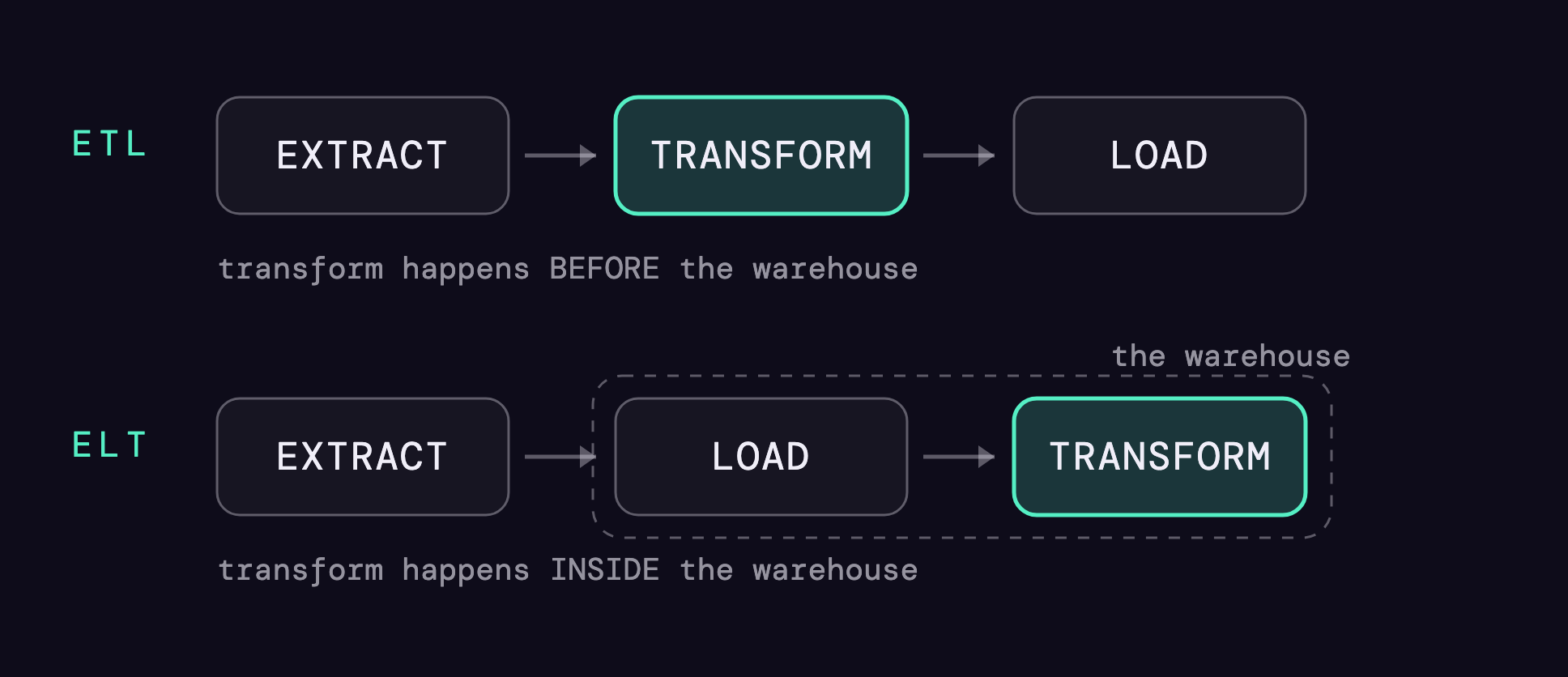
ETL: Extract → Transform → Load. Data is cleaned and shaped by a pipeline (Spark, Informatica, custom code) before it lands in the warehouse. The warehouse only ever sees finished tables.
ELT: Extract → Load → Transform. Raw data lands in the warehouse first, then gets transformed inside it, with SQL, typically orchestrated by dbt. The warehouse IS the transform engine.
When each one wins
ETL wins when:
- Compliance says clean before landing (PII stripping, GDPR)
- Warehouse compute is scarce or pricey
- The target is legacy or on-prem
- Schemas are stable and well known
ELT wins when:
- You run a cloud warehouse where compute is cheap and elastic
- Schemas evolve and you want to reprocess anytime
- Analysts own transforms in SQL and dbt
- Raw history has audit or debugging value
Side by side
| ETL | ELT | |
|---|---|---|
| transform runs | before load | in the warehouse |
| typical tools | Spark, Informatica | dbt + warehouse SQL |
| raw data kept | no | yes |
| who transforms | data engineers | engineers + analysts |
| flexibility | lower | higher |
Most modern cloud stacks land on ELT, with dbt as the T.
The trap: ELT is not "no modeling"
Loading raw data with no modeling layer builds a swamp, not a platform. ELT moves the T later, it does not delete it. The standard layer convention:
- raw: land data as-is, immutable, boring on purpose
- staging: rename, cast, clean. One model per source table.
- marts: business logic, joined and ready for BI
This is exactly the dbt layer convention, and it is what separates an ELT warehouse from a data swamp.
Frequently asked questions
Is ELT replacing ETL?
Where does dbt fit in ETL vs ELT?
Which should a small team choose?
Is ELT cheaper than ETL?
Get the free PDF
One page, print-ready, free to share. No signup needed.