Free intro data courses: which path should you start?
Four free intro data courses, one per path: Data Analyst, Data Scientist, Data Engineer, Business Analyst. Run real queries in your browser, no signup, no card. Here's how to pick.
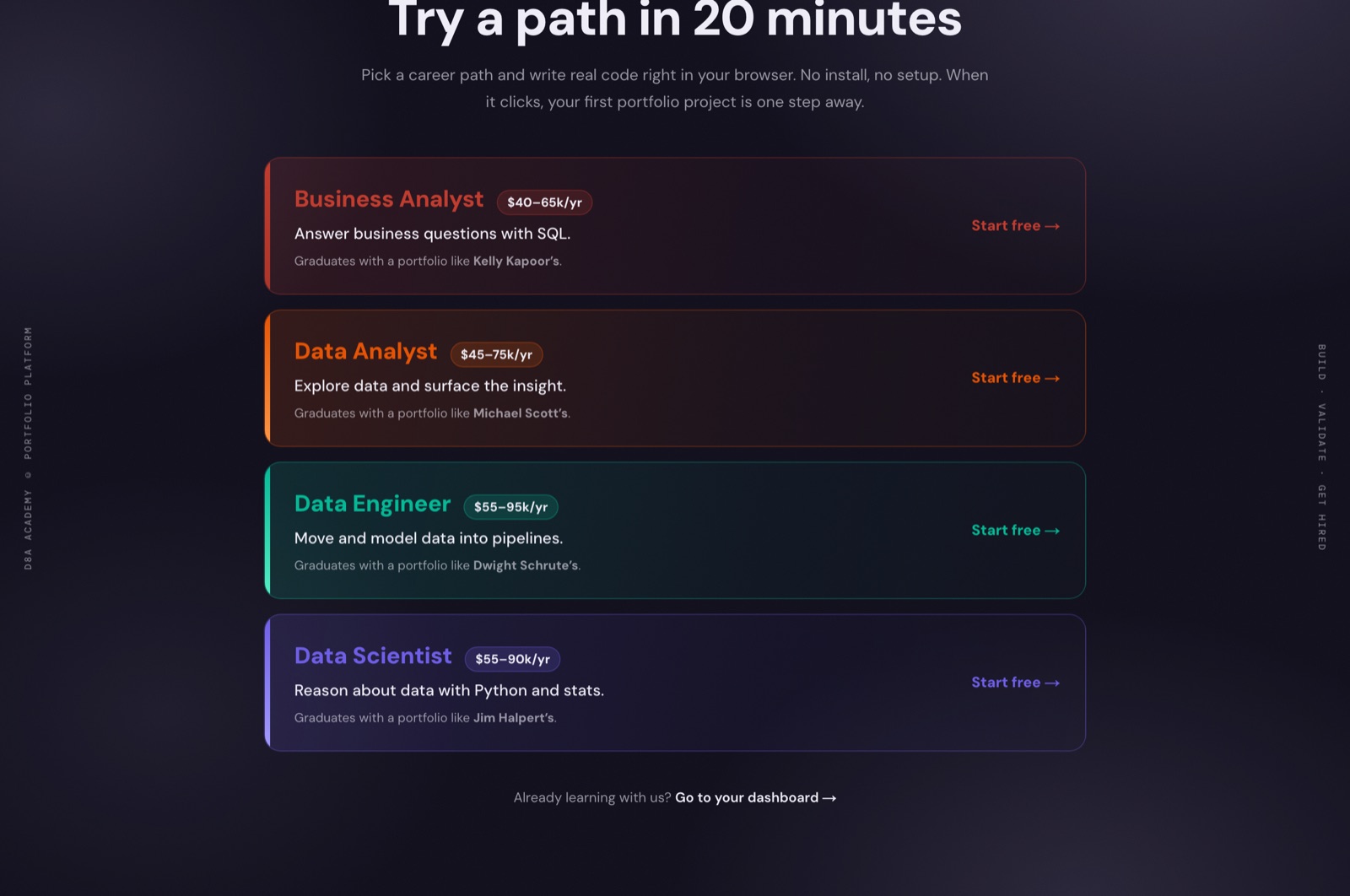
The hardest part of learning data isn't the SQL or the stats. It's picking a direction and trusting it enough to start. So instead of asking you to commit blind, we made the first step free: four intro courses, one per path, that you can run end to end in your browser. No signup, no card, no download. Here's what's inside each one, and how to choose.
Four free intros, one per path
Each of the four data paths opens with a free intro course you can finish in a sitting. They're not trailers, they're real lessons: you read a focused concept, then immediately put it to work in an in-browser playground where you write and run actual queries against actual data. Each intro ends with a quick check so you know whether it landed.
Answer real business questions with SQL and dashboards. The most transferable starting point, and where we point most newcomers.
Use statistics and machine learning to predict, classify, and cluster. A steeper climb with a higher ceiling.
Design the systems that move and transform data reliably. One of the most in-demand roles on the market right now.
Define requirements, map processes, and measure outcomes. An underrated, accessible way into data.
Every intro runs in your browser, including a live SQL playground. You write real queries against real data and see the results instantly. There's nothing to download and no environment to set up.
How to pick, in one question
Forget job titles for a second. The fastest way to choose is to ask what energizes you more, the result or the mechanism.
I want to turn messy data into a clear story
You'll enjoy SQL and dashboards, and the satisfaction of a number that changes someone's mind. Start with the Data Analyst intro, the most flexible foundation.
I want to build systems that predict things
You're drawn to math and uncertainty and want to write the algorithm, not just read its output. The Data Scientist intro is your taste test.
I care more about reliable infrastructure than insight
You think in pipelines, schemas, and uptime. You're closer to software engineering. Start with the Data Engineer intro.
I'm strongest in the room with stakeholders
You translate between what the business wants and what tech can build. The Business Analyst intro fits you.
Still torn? That's normal, and it's exactly what the 2-minute path quiz is for: it matches you to a path based on your background and what motivates you. If you want the full breakdown of how the roles differ, read DA, DS, DE, BA: what's the actual difference?.
What the roles look like, and pay
A free intro is the right way to feel out a path, but it helps to know where each one leads. These are typical European salary ranges; they climb meaningfully with experience.
| Path | What you do | Avg. market salary (EU) |
|---|---|---|
| Data Analyst | Answer business questions with SQL and dashboards | €40-65k |
| Data Scientist | Build predictive and ML models | €55-90k |
| Data Engineer | Build and maintain data pipelines | €55-85k |
| Business Analyst | Define requirements and measure outcomes | €35-60k |
Start with the question you most want to answer, then learn whatever skill gets you there fastest. The title follows the work.
After the intro: build, don't just watch
The intro answers one question: does this path click for me? If it does, the next step at D8A isn't more theory, it's building. Each path is a guided track of real projects with the datasets included, and every project you validate flows onto a public portfolio recruiters can open.
That's the whole idea: a certificate says you watched a course, a portfolio says you can do the work. The free intro is where you find out which path is worth building one in.
Pick the one that pulls at you and start, it's free, it runs in your browser, and there's no card required.